





Design custom blades for your generator and calculate power output at each wind speed.



Free sample chord sections can be generated for 0.70 m to 0.80 m blades (550 Watts - 710 Watts).



Free plans for 500 W blades with each purchase.










Design and construction of a
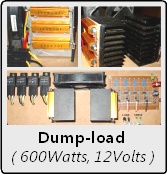
wind turbine dump-load charge controller
wind turbine dump-load charge controller
Abstract
Overcharging lead-acid batteries shortens life and capacity. If the battery voltage is not kept below 14.4 Volts, permanent capacity loss will occur. Voltage regulation is typically achieved by either stopping the wind turbine by shorting the generators EMF or by diverting (dumping) the power into a resistive load (heater). A universal 4-stage wind turbine charge controller circuit (with load) was designed and built for ~AU$140
Keywords: Wind Power, Dump-Load Charge Controller, Battery Voltage Conditioner, Overcharge Protection, Wind Turbine Voltage Regulator

| Figure | Page | |
| 1 | 12 Volt, 600 Watt dump-load charge controller circuit diagram | 2 |
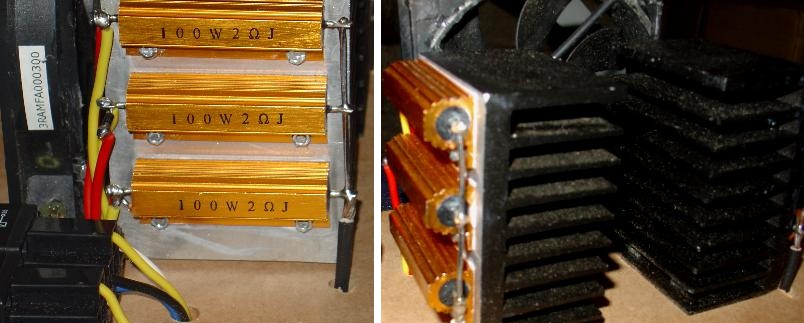
| 2 | 100 Watt 2 Ohm (dump-load) resistors mounted on a heatsink | 3 |
| 3 | Typical dump-load voltages in a 12 Volt system | 3 |
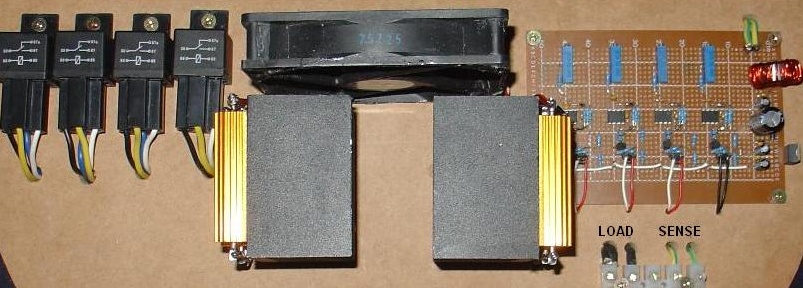
| 4 | Fully assembled 12 Volt four-stage 600 Watt dump load controller | 4 |
| 5 | Electronic components | 4 |

LIST OF FIGURES

1. Design of the dump-load controller
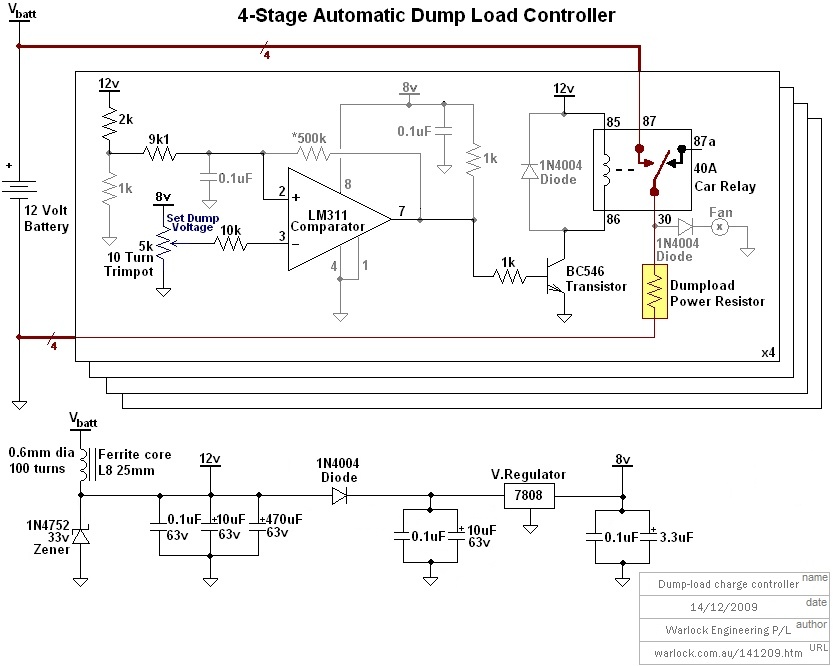
Dump-load circuits are not complex, this one has been assembled on veroboard and it uses a single IC (voltage comparator) to switch on an automotive relay when the voltage exceeds the pre-set threshold (5k trimpot). Each relay can divert a maximum of 40 Amps through the dump-load resistor, the maximum power per relay is 576 Watts (40A x 14.4V) or 1.2 kW in a 24 Volt system.
The voltage at the battery has significant noise due to the rectification of 3-phase AC-power. The input LC filter removes most of this noise and the Zener diode protects the circuit from any inductively induced voltage spikes. The 7808 voltage regulator supplies power to the comparator and is also the voltage reference for the trimpot. The circuit has 0.15 volts of hysteresis, set by the *500k resistor. Hysteresis can be increased by decreasing the value of this resistor.
Using the trimpots, the dump-voltages have been set between 13.75 volts to 14.4 volts as in Figure 3.
| relay | on-voltage | off-voltage | resistance | power | total-power |
| 1 | 13.90 V | 13.75 V | 2 Ohm | 100 W | 100 W |
| 2 | 14.00 V | 13.85 V | 2 Ohm | 100 W | 200 W |
| 3 | 14.20 V | 14.05 V | 1 Ohm | 200 W | 400 W |
| 4 | 14.30 V | 14.15 V | 1 Ohm | 200 W | 600 W |
Figure 3. Typical dump-load voltages in a 12 Volt system
Figure 4. Fully assembled 12 Volt four-stage 600 Watt dump load controller
Two pairs of wires (load and sense) connect the dump-load controller to the battery.
5. Comments


Frequently asked questions about plan orders, blade design, electrical work and generator matching can be found on our Q&A pages.
Related Articles
Figure 1. 12 Volt, 600 Watt dump-load charge controller circuit diagram


| Qty | Part | Description | Unit cost | Cost |
| 4 | LM311 | Comparator | $1.75 | $7.00 |
| 4 | BC547 | NPN Transistor | $0.26 | $1.04 |
| 1 | 7808 | Voltage Regulator, 8.0 Volts | $1.65 | $1.65 |
| 4 | 5k | 10-turn trimpot resistor | $1.75 | $7.00 |
| 9 | 1N4004 | Diode | $0.13 | $1.17 |
| 1 | 1N4752 | Zener diode , 33 Volts | $0.55 | $0.55 |
| 1 | L8 | 25x15x10mm Toroid Core | $1.75 | $1.75 |
| 28 | - | Resistors | $0.06 | $1.68 |
| 15 | - | Capicators | $0.35 | $5.25 |
| 1 | - | 305mm veroboard | $11.50 | $11.50 |
| Total | $38.95 |
Figure 5. Electronic components
3. System cost (AUD)



4. Additional Notes
1 - The heatsink gets warm with only a single fan cooling it, adding a second fan would increase cooling and reliability.


SPONSORED ADVERTISEMENT


SPONSORED ADVERTISEMENT






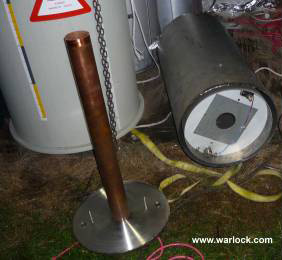
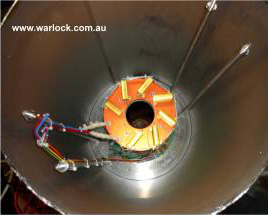
Figure 2. 100 Watt, 2 Ohm (dump-load) resistors mounted on a heatsink
Four separate loads (Figure 2) are made from six 100 Watt power resistors. Multiple loads increase reliability. They dissipate low watts in low wind and high watts in high wind, minimising battery discharge. They also have the advantage of requiring a lower hysteresis for reliable operation.


2. Assembling the dump-load controller
Heatsink $20
12 Volt Fan $12
electronic components $38.59
40 Amp automotive relays (x4) $24
2 Ohm (100 Watt) Resistors (x6) $48
Total cost $142.59
12 Volt Fan $12
electronic components $38.59
40 Amp automotive relays (x4) $24
2 Ohm (100 Watt) Resistors (x6) $48
Total cost $142.59




Using the trimpots, the dump-voltages have been set between 13.75 volts to 14.4 volts as in Figure 3.


Overcharging lead-acid batteries shortens life and capacity. If the battery voltage is not kept below 14.4 Volts permanent capacity loss will occur. Voltage regulation is typically achieved by either stopping the wind turbine by shorting the generators EMF or by diverting (dumping) the power into a resistive load (heater). A universal 4-stage wind turbine charge controller circuit (with load) was designed and built for ~AU$140
Abstract
Keywords: Wind Power, Dump-Load Charge Controller, Battery Voltage Conditioner, Overcharge Protection, Wind Turbine Voltage Regulator
Design and construction of a wind turbine dump-load charge controller


Dump-load circuits are not complex, this one has been assembled on veroboard, it uses a single IC (voltage comparator) to switch on an automotive relay when the voltage exceeds the pre-set threshold (5k trimpot). Each relay can divert a maximum of 40 Amps through the dump-load resistor, the maximum power per relay is 576 Watts (40A x 14.4V) or 1.2 kW in a 24 Volt system.
Figure 1. 12 Volt, 600 Watt dump-load charge controller circuit diagram
The voltage at the battery has significant noise due to the rectification of 3-phase ac-power. The input LC filter removes most of this noise, the Zener diode protects the circuit from any inductively induced voltage spikes. The 7808 voltage regulator supplies power to the comparator and is also the voltage reference for the trimpot. The circuit has 0.15 volts of hysteresis, set by the *500k resistor. Hysteresis can be increased by decreasing the value of this resistor.
1. Design of the dump-load controller
2. Assembling the dump-load controller
Figure 2. 100 Watt 2 Ohm (dump-load) resistors mounted on a heatsink
Figure 3. Typical dump-load voltages in a 12 Volt system

Relay
1
2
3
4
2
3
4
on
voltage
voltage
off
voltage
voltage
resistance
(Ohms)
(Ohms)
power
total
power
power
13.90
14.00
14.20
14.30
14.00
14.20
14.30
13.75
13.85
14.05
14.15
13.85
14.05
14.15
2
2
1
1
2
1
1
100 W
100 W
200 W
200 W
100 W
200 W
200 W
100 W
200 W
400 W
600 W
200 W
400 W
600 W
Figure 4. Fully assembled 12 Volt four-stage 600 Watt dump load controller
Two pairs of wires (load and sense) connect the dump-load controller to the battery.

Qty
4
4
1
4
9
1
1
28
15
1
4
1
4
9
1
1
28
15
1
Part
Description
Cost
LM311
BC547
7808
5k
1N4004
1N4752
L8
-
-
-
BC547
7808
5k
1N4004
1N4752
L8
-
-
-
Comparator
NPN Transistor
Voltage Regulator (8.0V)
10-turn trimpot resistor
Diode
NPN Transistor
Voltage Regulator (8.0V)
10-turn trimpot resistor
Diode
$7.00
$1.07
$1.65
$7.00
$1.17
$0.55
$1.75
$1.68
$5.25
$11.50
$1.07
$1.65
$7.00
$1.17
$0.55
$1.75
$1.68
$5.25
$11.50


Using the trimpots, the dump-voltages have been set between 13.75 to 14.4 volts as in Figure 3.
Total $38.95
Figure 5. Electronic Components
Heatsink $20
12 Volt Fan $12
electronic components $38.59
40 Amp automotive relays (x4) $24
2 Ohm (100 Watt) Resistors (x6) $48
Total cost $142.59
12 Volt Fan $12
electronic components $38.59
40 Amp automotive relays (x4) $24
2 Ohm (100 Watt) Resistors (x6) $48
Total cost $142.59
3. System cost (AUD)

4. Additional Notes


Continue to summaries about.....

VAWT Wind Turbine
Related Articles
Zener diode, 33V
25x15x10 mm toroid core
Resistors
Capacitors
305 mm veroboard
25x15x10 mm toroid core
Resistors
Capacitors
305 mm veroboard
Four separate loads (Figure 2) are made from six 100 watt power resistors, multiple loads increase reliability, they dissipate low watts in low wind and high watts in high wind minimising battery discharge. They also have the advantage of requiring a lower hysteresis for reliable operation.
1 - The heatsink gets warm with only a single fan cooling it, adding a second fan would increase cooling and reliability.





1.4 Metre Diameter 3-Blade Wind Turbine Construction
5. Comments

